

R2000 LiDAR Sensor: Three Intelligent Features for Greater Precision, Availability, and Flexibility
Content of This Article
The Pepperl+Fuchs R2000 series LiDAR sensors combine precise measurement technology with intelligent additional features that go far beyond traditional LiDAR detection:
- Lens Contamination Monitoring enhances operational reliability by detecting contamination early.
- Hardware Timestamp ensures high-precision time synchronization and improved navigation accuracy.
- I/O Access simplifies the integration of external devices and triggers.
In modern automation and logistics applications, raw LiDAR measurement performance is no longer the sole deciding factor. Equally important is the ability to efficiently process, synchronize, and seamlessly integrate sensor data into existing systems. The R2000 series LiDAR sensors from Pepperl+Fuchs offer a range of powerful functions providing real added value, particularly in mobile robotic systems, intralogistics, and complex multi-sensor applications. In addition to filtering options for the efficient preprocessing of LiDAR measurement data, three key features stand out: Lens Contamination Monitoring (LCM), Hardware Timestamp, and I/O Access. Learn more about these features and the benefits they provide in a wide range of applications.
Monitor Lens Contamination Before Performance Is Affected
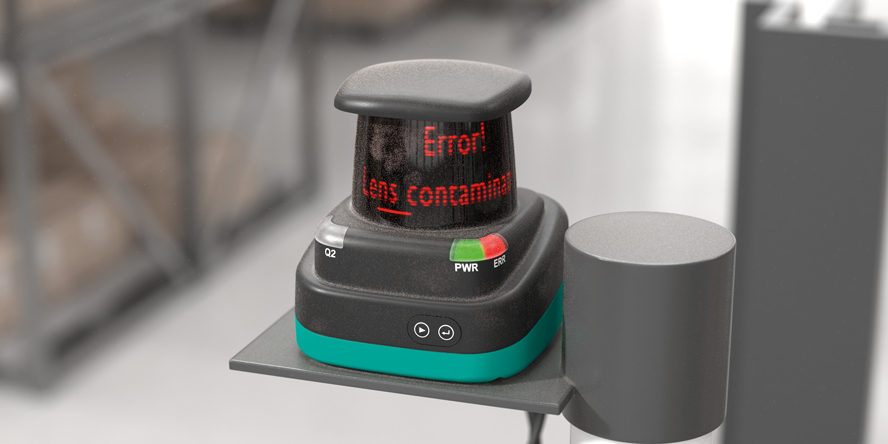
In industrial applications, dust, dirt, or deposits can significantly impair the performance of optical sensors. To address this challenge, the R2000 LiDAR sensor features an integrated Lens Contamination Monitor (LCM), which continuously monitors the contamination level of the scanner lens and alerts users at an early stage on critical changes.
For monitoring purposes, the LiDAR sensor’s field of view is divided into twelve individual sectors, each covering a 30° angle. The LCM evaluates the level of contamination in each sector separately and compares the measured values with predefined warning and error limit values. If a limit value is exceeded, the system automatically generates a corresponding warning or error message for the affected area.
Monitoring can be individually enabled or disabled for each sector, preventing unnecessary alerts from areas outside the field of view relevant to the application. Additionally, the sensitivity and response time of the LCM can be adjusted to match the specific application requirements and environmental conditions.
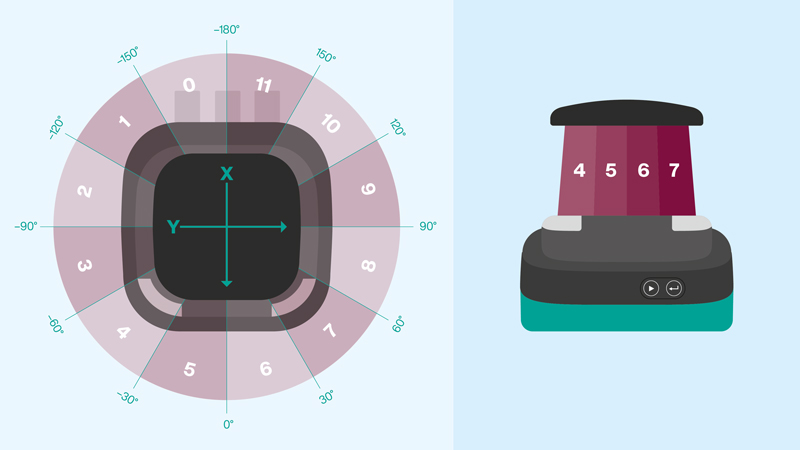
R2000 LiDAR sensor features an integrated lens contamination monitoring, divided into 12 sectors.
Higher Plant Availability Through Early Warning
Lens Contamination Monitoring supports predictive maintenance by detecting contamination on the scanner lens at an early stage. Users receive timely warnings and can perform cleaning procedures before measurement quality deteriorates or a sensor failure occurs. As a result, LCM increases operational reliability and ensures reliable sensor performance even under demanding environmental conditions.
Hardware Timestamp Ensures a Precise Time Base for Sensor Data
Accurate sensor data interpretation depends not only on what was measured, but also on when it was measured. The Hardware Timestamp function of the R2000 LiDAR sensor enables highly precise temporal assignment of every individual scan point. The LiDAR sensor assigns an internal timestamp (“raw timestamp”) to each measured value, which is generated directly by an integrated system clock. This clock starts at zero when the sensor is powered on, runs continuously without overflows, and offers sub-millisecond resolution with a drift of less than 100 ppm.
Sub-Millisecond Synchronization Accuracy for Stable Multi-Sensor Systems
Compared to software-based time synchronization via Ethernet, Hardware Timestamp minimizes the impact of network delays, latencies, or jitter. This enables synchronization of the sensor’s internal time with the system clock of an external client to an accuracy of less than 1 ms.
Furthermore, the Hardware Timestamp forms the basis for reliable sensor fusion in multi-sensor systems. Precise temporal synchronization of all sensor data allows environmental information to be merged more accurately, improves object detection reliability, and significantly enhances the stability of SLAM (Simultaneous Localization and Mapping) and navigation algorithms.

The Hardware Timestamp function of the R2000 LiDAR sensor enhances the stability of SLAM (Simultaneous Localization and Mapping) and navigation algorithms in multi-sensor systems.
Navigation Accuracy for Mobile Robots and Autonomous Vehicles
The precise time base offers particular advantages in applications where fast movements or multiple sensors must be taken into account simultaneously. During AGV and AMR navigation, for example, sensors are constantly moving through space. Even minimal time deviations can lead to noticeable positioning and navigation errors. Since the R2000 LiDAR sensor records the exact timestamp of each scan point, the client application can perform precise motion compensation, ensuring accurate measurement data even when the vehicle is moving at higher speeds.
I/O Access for Enhanced Flexibility Directly at the Sensor
The R2000’s I/O Access feature enables the flexible use of up to four discrete digital I/O channels, which can be individually configured as input or output. This allows users to connect external devices and signals directly to the sensor. In addition to capturing measurement data, the LiDAR sensor can therefore also handle basic control and triggering tasks.
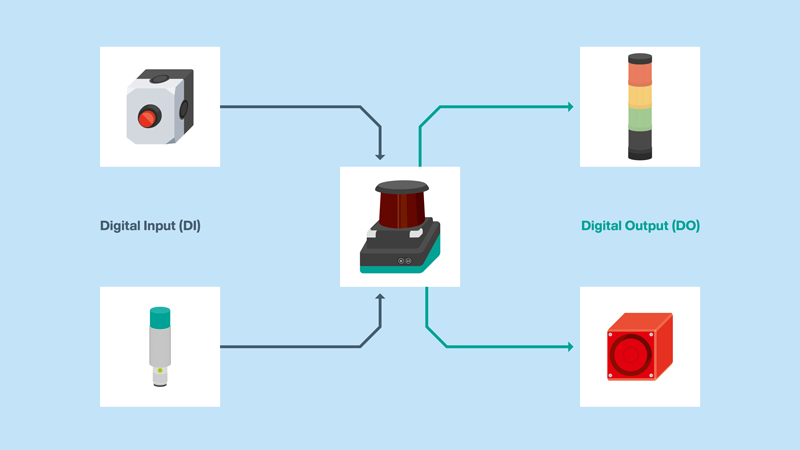
The R2000 LiDAR sensor features up to four discrete digital I/O channels, which can be individually configured as input or output.
Easily Control Peripheral Devices
Typical peripheral devices located near the sensor—such as signal beacons, buzzers, or valves—can be controlled directly via the sensor, without the need for additional PLC hardware. This reduces wiring effort, additional hardware, and integration complexity within the system. Especially in compact machine designs or mobile applications such as AGVs and AMRs, this significantly simplifies system integration.
Directly Detect External Triggers
With the integrated I/O Access function, the LiDAR sensor can also capture external events directly within the sensor, for example, via light barriers or push buttons. This makes it even easier to integrate the R2000 into existing machine and system architectures, and to adapt it flexibly to a wide range of automation tasks.
More Information
Applications of the R2000 LiDAR Sensor:
Subscribe to our newsletter and receive regular news and interesting facts from the world of automation.