

How to Choose the Right Volume Measurement for Your System
Content of This Article
An incorrectly sized pallet, inaccurate bulk material measurement, a misrouted package—errors in volume measurement cost time and money. Pepperl+Fuchs addresses precisely these challenges with two specialized solutions: the Volume3D sensor system, based on LiDAR technology, and the SmartRunner Measurer 3-D vision sensor. This blog post explains how the two technologies differ and which best fits your application.
LiDAR vs. 3-D Vision: A Comparison of Two Volume Measurement Technologies
The Volume3D sensor system uses up to three LiDAR sensors mounted above the conveyor belt for volume measurement. Pulse Ranging Technology (PRT), developed in-house by Pepperl+Fuchs, enables these sensors to measure the distance to the target object with very high angular resolution, producing a high-precision distance profile. Combined with the motion data from a rotary encoder mounted on the conveyor belt, the system assembles multiple cross-sectional images into a complete 3-D image. A separate evaluation unit handles data analysis.
The SmartRunner Measurer 3-D vision sensor, by contrast, captures a full 3-D image in a single shot. It relies on stereo vision technology: two cameras arranged at an offset simultaneously capture the scene from different perspectives. From the disparity between the two images, the SmartRunner Measurer 3-D calculates precise depth information via triangulation and renders the object completely in 3-D—in both static and dynamic applications with speeds up to 2.5 m/s. All data is evaluated directly within the sensor, with no external image processing required.
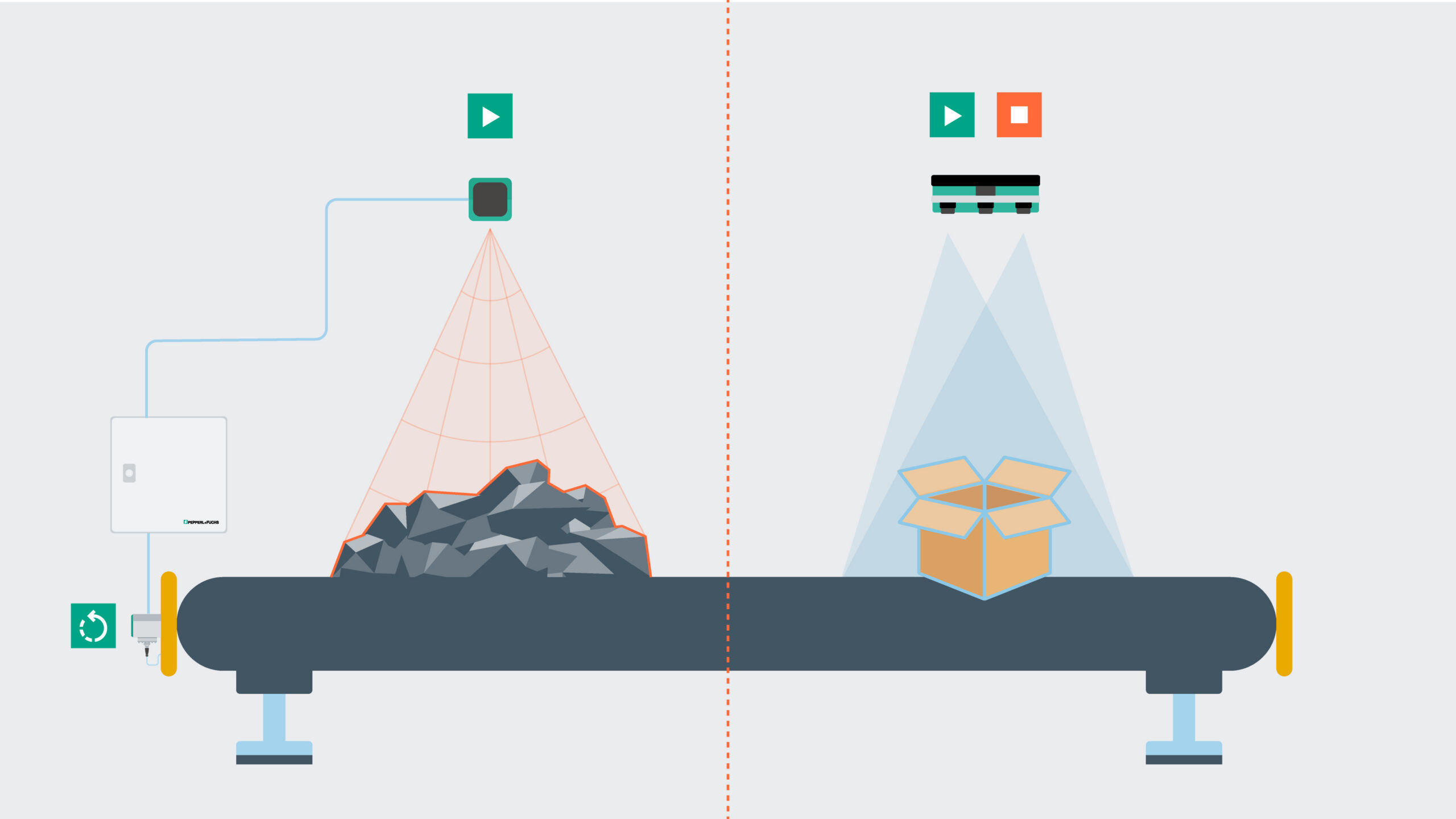
The Volume3D sensor system (left) consists of one or more LiDAR sensors, a rotary encoder, and an evaluation unit. The SmartRunner Measurer 3-D (right) measures object volume using stereo vision technology, both when stationary and in motion.
Volume Measurement of Bulk Materials in Mining: Volume3D LiDAR Sensor System
In the mining industry, a wide variety of bulk materials, such as various types of ore, soil, and similar substances, are transported via conveyor belts to loading silos and other facility areas. At strategic points along the conveyor route, the volume of the bulk material must be determined accurately. The system used for this purpose must not only handle continuous material flows reliably but also withstand harsh operating conditions, where dirt and dust are ever-present.
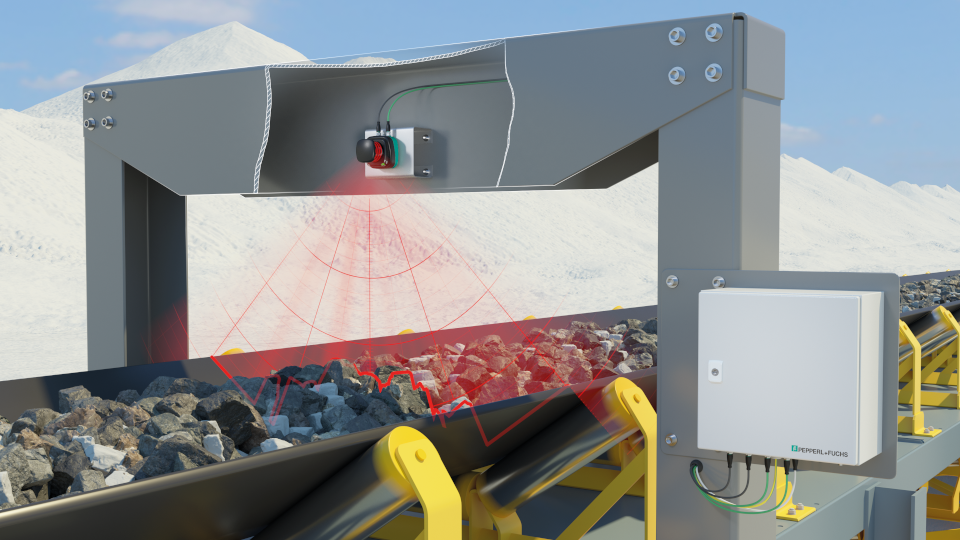
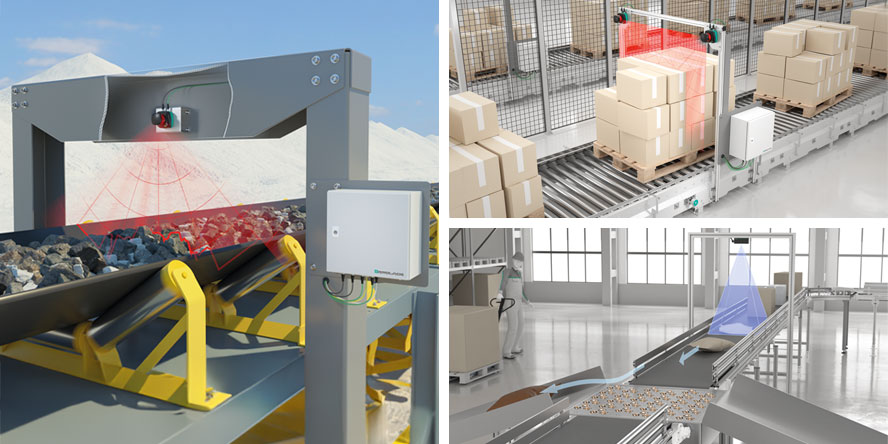
The Volume3D system measures the volume of ore on conveyor belts in mining operations without physical contact.
Under these challenging conditions, the Volume3D sensor system ensures reliable volume measurement. The R2000 2-D LiDAR sensor delivers the highest precision through an angular resolution of 0.042° and a scan rate of up to 50 Hz. Intelligent software integrated into the multiscan evaluation unit (MSEU) filters out invalid measurement points, ensuring consistently accurate results. To withstand dirt and dust, the R2000 features an integrated Lens Contamination Monitor (LCM) that evaluates the degree of lens contamination—allowing timely, need-based cleaning and uninterrupted operation in even the most demanding mining environments.
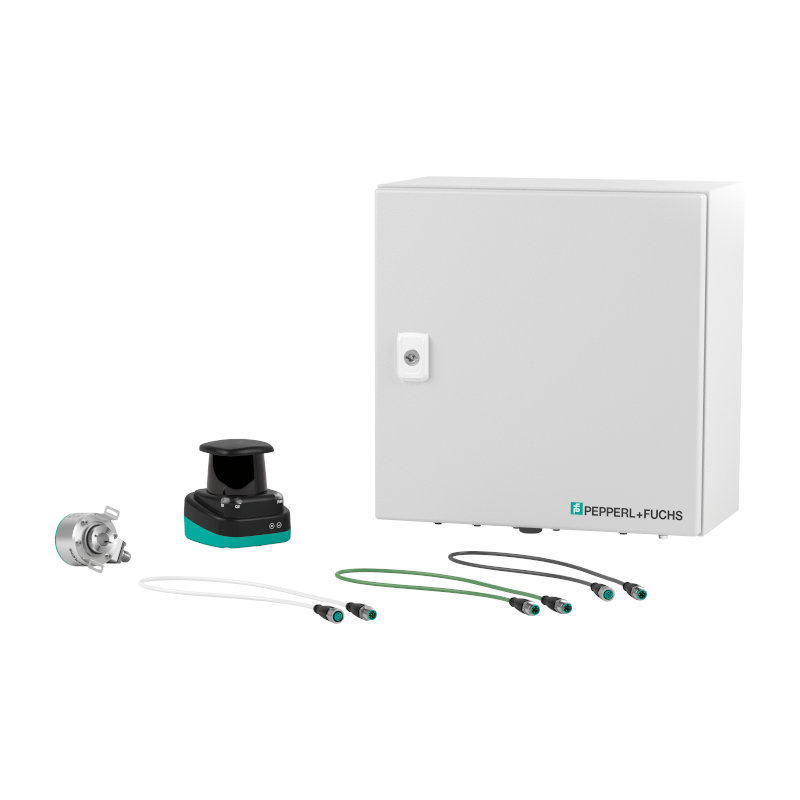
The Volume3D sensor system: rotary encoder, LiDAR sensor, and evaluation unit
Volume Measurement for Irregularly Loaded Pallets: Volume3D LiDAR Sensor System
Intralogistics also involves challenging applications where volume measurement with Volume3D is the ideal solution—palletizing being a key example. Pallets are frequently loaded irregularly, with individual packages shifted or protruding beyond the stack. Such large, uneven structures are difficult to measure. If only a single sensor is used, shadowing effects can occur that compromise accuracy.
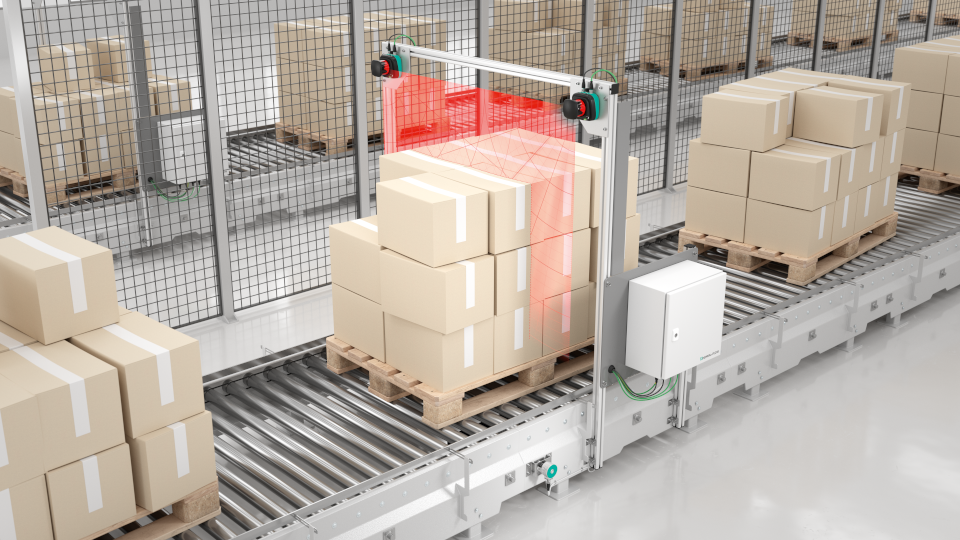
With two LiDAR sensors, the Volume3D sensor system compensates for shadowing effects on irregularly loaded pallets.
To address this, the Volume3D volume measurement system supports the parallel operation of up to three LiDAR sensors. Two sensors mounted on either side above the conveyor belt capture the pallet from different angles. The evaluation unit then fuses the measurement points from both sensors into a shadow-free point cloud, enabling reliable calculation of the pallet volume.
Volume Measurement in Sorting Systems: SmartRunner Measurer 3-D Vision Sensor
Many standard intralogistics applications do not involve continuous material flows or complex structures but instead focus on straightforward volume measurement of individual objects. In sorting systems, for instance, each bag or package on the conveyor belt must be captured individually.
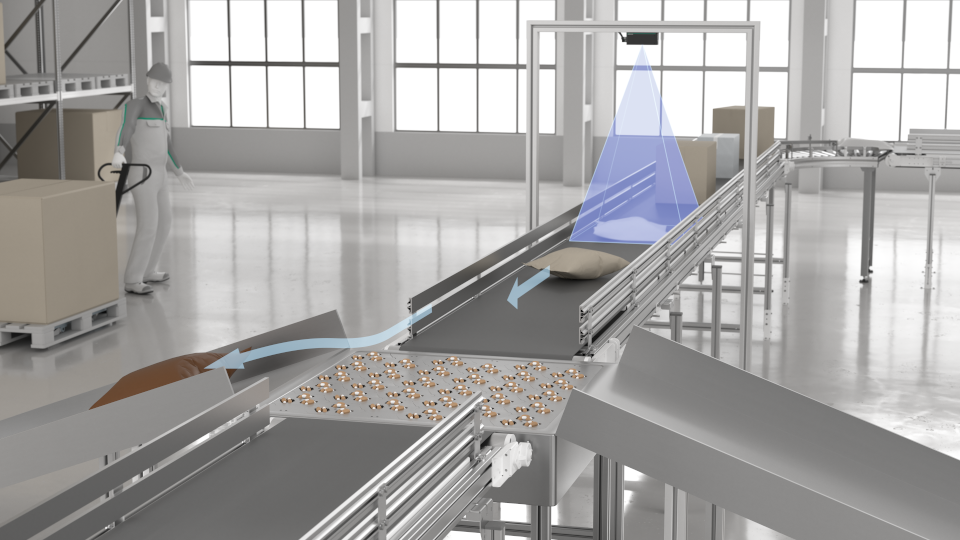
In sorting systems, the SmartRunner Measurer 3-D ensures simple, straightforward volume measurement.
For these applications, the SmartRunner Measurer 3-D vision sensor offers a particularly efficient solution. Users benefit from minimal time and installation effort: A single sensor generates complete 3-D images of both stationary and moving objects at speeds of up to 2.5 m/s, with no rotary encoder needed for motion data. Data processing takes place entirely within the sensor, eliminating the need for external image processing. Beyond volume, the sensor also delivers measurement results for rotation, position, and dimensions—opening up additional application possibilities. The SmartRunner Measurer 3-D can be easily integrated into virtually any automation environment via Modbus TCP or Ethernet TCP/IP.
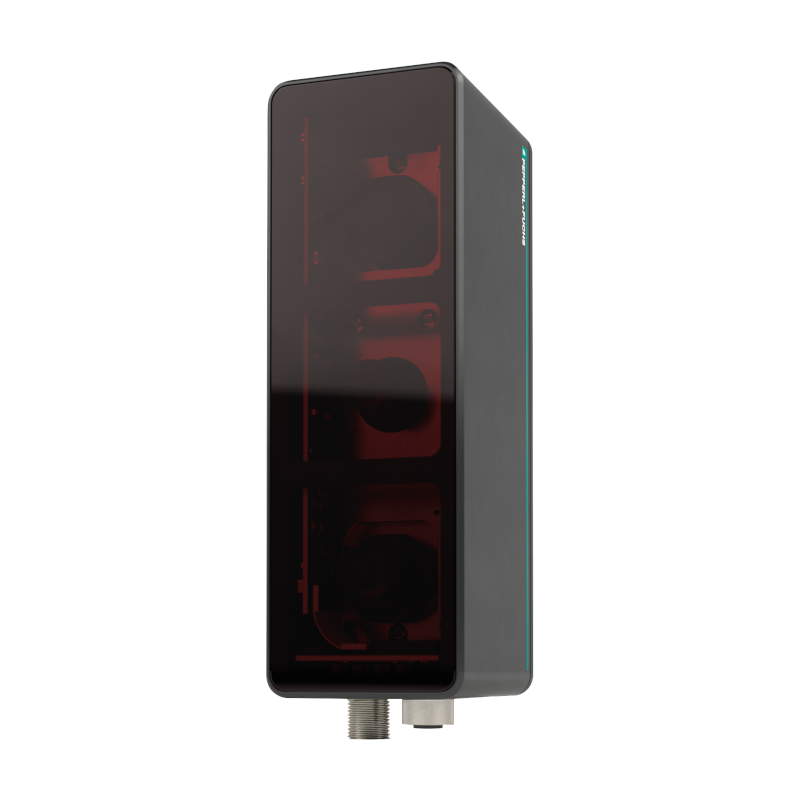
The SmartRunner Measurer 3-D vision sensor
Volume3D vs. SmartRunner Measurer 3-D: An Overview of the Differences
| Volume3D | SmartRunner Measurer 3-D | |
|---|---|---|
| Basic concept | Modular system with LiDAR sensor(s), rotary encoder, and evaluation unit | Compact sensor with integrated evaluation |
| Measurement technology | 2-D LiDAR plus velocity data for 3-D calculation | Stereo vision technology |
| Target application | Continuous volume and object measurement on conveyor belts | Measurement of individual objects |
| Object type | All types, including bulk goods, material flows, and pallets | Individual objects, e.g., packages, bags |
| Dynamics | Dynamic applications only | Static and dynamic applications up to 2.5 m/s |
| Output data | Volume, volume flow, conveyor belt load, height profile, dimensions, maximum/average loading height | Volume, dimensions, rotation, position |
| Integration | TCP/IP, fieldbus via system modules or gateways | TCP/IP, Modbus TCP |
| Application examples | Bulk material measurement in mining, recycling, or agriculture; pallet measurement; conveyor belt monitoring | Sorting systems, automated order-picking, packaging systems, object measurement, picking |
| Go to product | Go to product |
Conclusion
Every application places different demands on volume measurement. With the Volume3D sensor system and the SmartRunner Measurer 3-D, Pepperl+Fuchs offers two purpose-built solutions covering a broad range of industrial requirements, from standard intralogistics tasks to more demanding scenarios in mining or palletizing. Contact our experts to find out which solution is the right fit for your facility.
Subscribe to our newsletter and receive regular news and interesting facts from the world of automation.