

When Should I Use a NAMUR Output Sensor? Fundamentals, Benefits, and Applications
Content of This Article
- Designed for explosion-hazardous areas: NAMUR sensors operate at low current and voltage levels and, when used with a compatible switch amplifier, are also suitable for intrinsically safe applications in explosion-hazardous areas.
- Built-in fault detection: Unlike standard sensors, NAMUR output sensors can detect not just “on” and “off” but also short circuits and lead breakage, providing a major advantage for fault detection and process reliability.
- Functional safety: When paired with a compatible fail-safe switch amplifier, NAMUR sensors can achieve safety integrity level SIL 2 in accordance with EN/IEC 61508 standards, and SIL 3 in redundant circuits.
- In accordance with international standards: NAMUR output sensors comply with EN/IEC 60947-5-6, ensuring safe, consistent, interoperable performance across global installations.
If you are working in an explosion-hazardous area, need a sensor with built-in fault detection, or are setting up an intrinsically safe circuit or a safety-certified system, a NAMUR sensor is often the right choice, or even the required one. Sensors with NAMUR outputs offer a combination of functions and features that no conventional sensor can match: intrinsic safety for explosion-hazardous areas, detection of short circuits and lead breakage before failures occur, compatibility with SIL-certified safety systems, and compliance with globally recognized standards. NAMUR sensors provide the reliability and safety that critical processes require—whether in chemical plants, on offshore platforms, in the pharmaceutical industry, in paint shops, or in wastewater treatment.
In this blog post, we explain what a NAMUR output sensor is, how it works, its key benefits, and its areas of application.
What Is a NAMUR Output Sensor?
A NAMUR sensor is a non-amplified two-wire proximity sensor with a NAMUR output that provides two distinct signal levels depending on its switching state. These signal levels operate at low-level current and voltage, which means that a switch amplifier is required to read and interpret the current levels. Due to their low-power design and built-in fault detection capabilities, NAMUR output sensors are most commonly deployed in facilities where special safety measures are required, including locations with explosion hazards or strict requirements for personnel protection and machine safety.
The relevant international standards governing NAMUR output sensors are EN/IEC 60947-5-6.
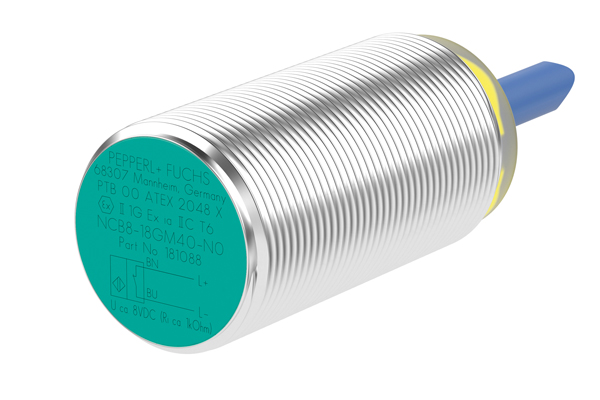
Pepperl+Fuchs inductive sensor with NAMUR output
How Does a NAMUR Output Sensor Operate?
A NAMUR output sensor can be configured as either a normally open or normally closed contact, with normally open being the typical default setting. One of the key technical characteristics of this sensor type is that its output is solid-state, meaning a small current is always present on the output line, regardless of whether the sensor is activated. This is not a flaw; it is by design. Unlike traditional proximity sensors, a NAMUR sensor does not output a switching signal, but merely changes its current level. Due to the low-current switching levels, the NAMUR sensor must be connected to an approved switch amplifier or an input specifically designed for NAMUR.
Key operating parameters of a NAMUR sensor:
- Nominal voltage: 8.2 V DC
- Load: 1 kΩ
- Current for detected state (target present): ≤ 1.2 mA
- Current for not detected state (no target): ≥ 2.1 mA
The Key Advantage of NAMUR Sensors: Built-in Fault Detection
A key advantage of a NAMUR output sensor over a conventional PNP/NPN switch is its ability to detect short circuits and wiring faults, not just the presence or absence of a target object. A standard proximity sensor delivers only two states: “On” or “Off.” A NAMUR sensor, on the other hand, provides four distinguishable states:
| Condition | Current Level |
|---|---|
| Target detected (active) | ≤ 1.2 mA |
| No target (inactive) | ≥ 2.1 mA |
| Short circuit | ≥ 6.5 mA |
| Cable break / wire fault | ≤ 0.15 mA |
NAMUR sensors can distinguish between “no target detected” and “the sensor has lost its cable connection.” This built-in diagnostic capability is a crucial advantage in the process industry, as a false sensor signal could lead to dangerous conditions or costly unplanned downtime.
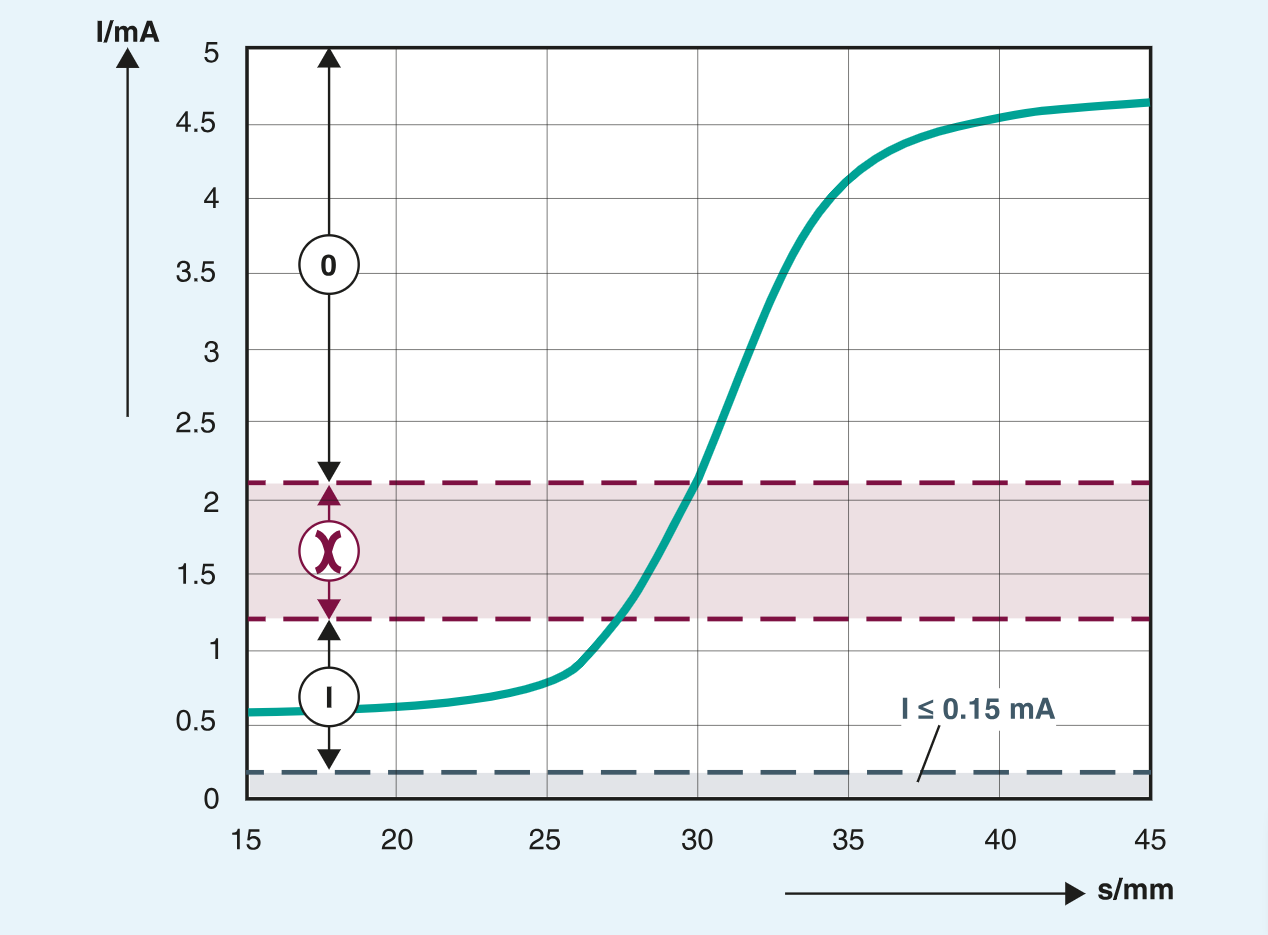
A NAMUR sensor does not output a switching signal; instead, it changes its current level depending on whether a target object is present or not, or whether a short circuit or a broken wire is detected.
What Applications Can Be Addressed with NAMUR Sensors?
NAMUR sensors are used wherever reliable detection and line monitoring are required in explosion-hazardous areas or harsh industrial environments.
Typical Applications:
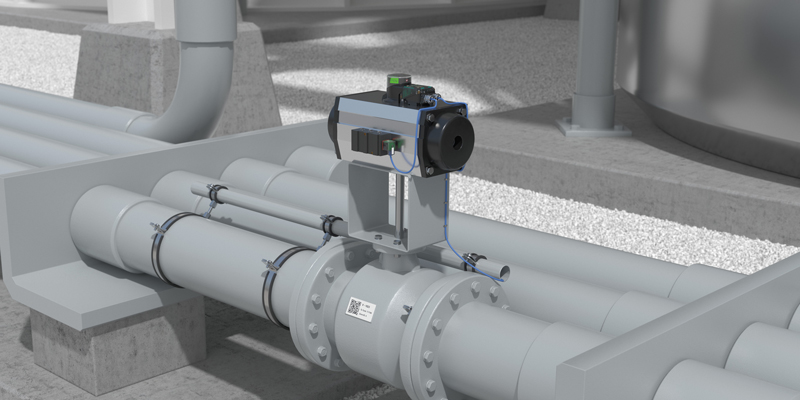
- Limit position detection and valve position feedback for automated control or regulating valves in process engineering, for example, to determine whether dampers and valves are fully open or closed
- Rotational speed detection of mixers, pumps, and agitators, or rotating components of machines, shafts, and turbines in process plants
- A lead breakage or short circuit to the sensor can be detected immediately based on changes in current level

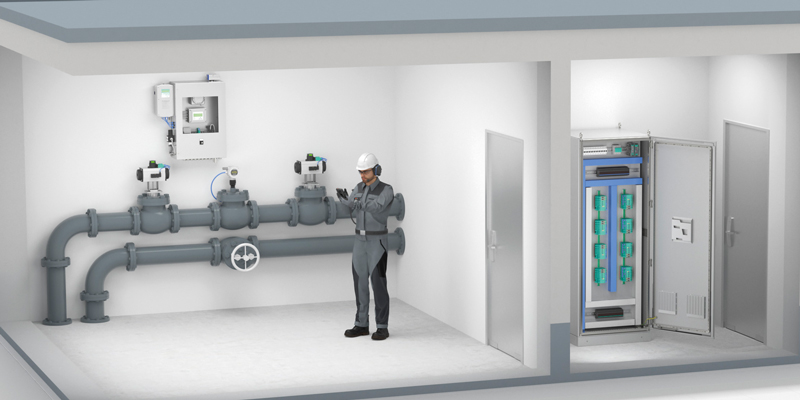

Typical Industries:
- Chemical and petrochemical industries
- Oil and gas industry
- Hydrogen industry
- Offshore platforms
- Wastewater treatment/sewage treatment plants
- Pharmaceutical industry
- Paint shops
- Distilleries, large-scale bakeries, grain silos
NAMUR Sensors for Intrinsically Safe Applications (Ex i)
NAMUR sensors with Ex-ia conformity assessment in accordance with EN/IEC 60079-11 are designed for intrinsically safe applications in explosion-hazardous areas up to Zone 0/20 and Class I, Division 1. These sensors must be used in conjunction with an approved intrinsically safe input or an intrinsic safety barrier that limits current and voltage to a safe level in the event of a fault.
Advantage of Intrinsic Safety:
A particular advantage of intrinsic safety (Ex i) over all other types of protection is that the NAMUR sensor can be disconnected, replaced, or serviced during operation without having to shut down the affected area of the plant.
Global Use:
In addition to global approvals from leading certification bodies such as ATEX, IEC-Ex, CCC-Ex, and UL, NAMUR sensors also hold a wide range of national approvals from various countries, such as CCOE (India), JP-Ex (Japan), KC Ex (Korea), etc. This enables NAMUR sensors to be widely used in explosion-hazardous areas in plants worldwide.
The NAMUR sensor is mounted directly in the explosion-hazardous or classified area, while the intrinsic safety barrier and the power supply must be installed in the non-Ex area.
Verification of Intrinsic Safety:
In addition to the Ex i certification of the apparatus, calculational verification for the entire intrinsically safe circuit (sensor, cable, isolating amplifier) in accordance with EN/IEC 60079-14 is required as verification of intrinsic safety. This verification is reviewed and evaluated by the appropriate test facilities.
Did you know?
There are automation tasks in Zone 2 (gas) and Zone 22 (dust) explosion-hazardous areas that can also be solved using standard PNP/NPN sensors with Ex ec/Ex tc certification. These involve purely mechanical explosion protection, increased safety (Ex ec) and enclosure protection (Ex tc), whereas the Ex i type of protection involves electrical explosion protection.
Fail-Safe NAMUR Sensors for Personnel and Machine Safety
In applications where personnel safety and machine safety are of critical importance, the requirements go beyond mere explosion protection. Some NAMUR output sensors are available with fail-safe outputs designed to achieve SIL 2 or SIL 3 ratings when paired with an appropriate switch amplifier, meeting the functional safety demands according to IEC 61508 and related standards.
A fail-safe output works by ensuring that if a fault occurs anywhere in the sensor circuit, the device detects the issue and automatically switches to a safe state. To use a fail-safe NAMUR output, a fail-safe-rated input or switch amplifier is required. This switch amplifier can be dual-rated, providing both personnel safety protection and protection for classified hazardous-area environments containing gases, dusts, or fibers.
When the fail-safe NAMUR sensor and switch amplifier are combined in redundant loops, they are capable of achieving a SIL 3 rating.
In Summary: When Is a NAMUR Sensor the Right Choice?
For automation tasks in hazardous areas, where process safety and the detection of lead breakage and wiring faults play a key role, a sensor with a NAMUR output offers significant advantages. When explosion hazards and personnel safety enter the picture, the NAMUR output sensor is often not just the better choice—it may be the only compliant one. For intrinsically safe circuits, NAMUR sensors with Ex i certification are used. In applications where personnel protection and functional safety are required, NAMUR sensors with fail-safe outputs are available.
NAMUR Devices from Pepperl+Fuchs
NAMUR output sensors:
- Inductive sensors with NAMUR output
- Capacitive sensors NAMUR output
- Magnetic Field sensors with NAMUR output
Switch amplifiers with NAMUR inputs:
More Information
- Visit our knowledge base for industrial sensors: 2-Wire Sensors According to NAMUR
FAQ
What Does NAMUR Stand For?
The name NAMUR comes from the German acronym “Normenarbeitsgemeinschaft für Mess- und Regeltechnik”, which translates to the Standards Association for Measurement and Control in the Chemical Industry. The organization has its origins in the chemical industry. Today, NAMUR is an international association of user companies in the automation and process industry, such as chemicals, pharmaceuticals, and petrochemicals. Founded in 1949 and headquartered in Leverkusen/Germany, the association pools expertise in standardization, digitalization, and automation technology to make industrial processes more efficient, safer, and more sustainable.
Learn more about NAMUR
What Is Intrinsic Safety?
Intrinsic safety (Ex i) type of protection is based on the protection principle of prevention according to IEC/EN 60079-11. By limiting current, voltage, and power within a circuit to a non-ignitable level, intrinsically safe equipment eliminates the source of ignition risk at the device level.
More on this topic: Intrinsic Safety Type of Protection: A Fundamental Overview
What Does “Ex ia” Stand for in Intrinsically Safe Applications?
Within intrinsic safety (Ex i), there are three protection levels (Ex ia, Ex ib, and Ex ic) that differ in the number of simultaneous faults permitted. “Ex ia” offers the highest safety level within intrinsic safety and ensures ignition protection through two protective measures, enabling safe normal operation even if two faults occur simultaneously in the circuit.
More on this topic: Ensuring Product Safety in Hazardous Areas with Intrinsic Safety
Subscribe to our newsletter and receive regular news and interesting facts from the world of automation.